what is the deadline to lower climate change
The earth'south leading climate scientists have warned there is only a dozen years for global warming to be kept to a maximum of 1.5C, beyond which even one-half a degree will significantly worsen the risks of drought, floods, extreme heat and poverty for hundreds of millions of people.
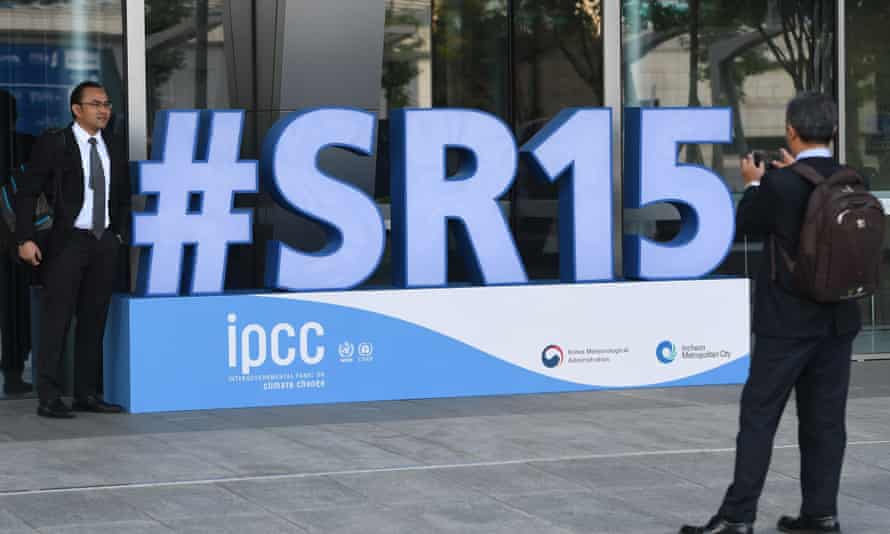
The authors of the landmark report by the Un Intergovernmental Console on Climatic change (IPCC) released on Monday say urgent and unprecedented changes are needed to achieve the target, which they say is affordable and feasible although information technology lies at the most ambitious end of the Paris agreement pledge to go on temperatures between i.5C and 2C.
The half-caste difference could too forbid corals from beingness completely eradicated and ease pressure on the Arctic, according to the 1.5C study, which was launched afterwards blessing at a final plenary of all 195 countries in Incheon in Southward Korea that saw delegates hugging one another, with some in tears.
Quick Guide What deviation would restricting warming to 1.5C make?
Show
A key finding of the new IPCC report is the dramatic difference that restricting warming to i.5C above pre industrial levels would have on the global environment.
The scientists institute:
• By 2100, global sea level rise would be 10cm lower with global warming of 1.5C compared with 2C.
• Extreme heatwaves volition be experienced by 14% of the world'due south population at least in one case every five years at one.5C. But that figure rises to more than than a third of the planet if temperatures rise to 2C
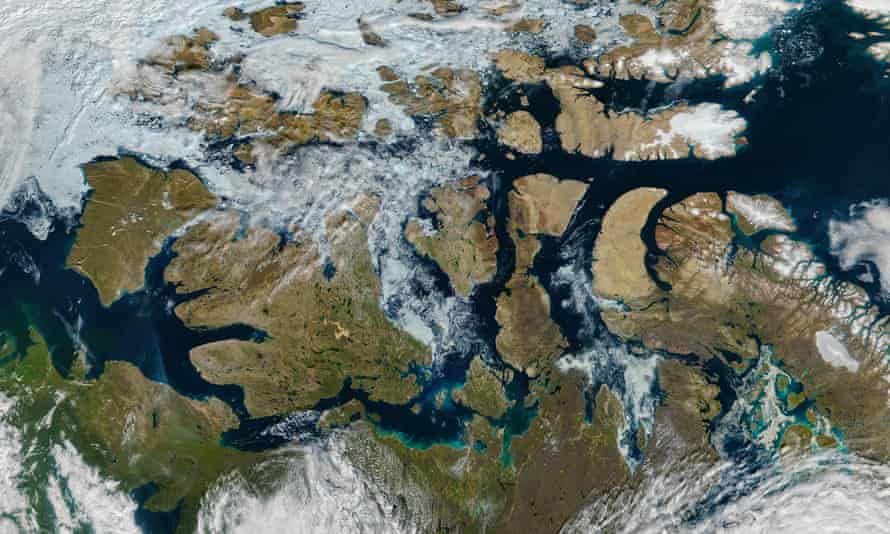
• Arctic bounding main ice would remain during most summers if warming is kept to 1.5C. But at 2C, water ice free summers are 10 times more probable, leading to greater habitat losses for polar bears, whales, seals and body of water birds.
• If warming is kept to 1.5C, coral reefs volition still pass up by 70-ninety% but if temperatures rise to 2C virtually all of the world's reefs would exist lost
"It'due south a line in the sand and what information technology says to our species is that this is the moment and we must deed now," said Debra Roberts, a co-chair of the working group on impacts. "This is the largest clarion bell from the science community and I hope it mobilises people and dents the mood of complacency."
Policymakers commissioned the report at the Paris climate talks in 2016, but since then the gap between scientific discipline and politics has widened. Donald Trump has promised to withdraw the US – the world's biggest source of historical emissions – from the accord. The first round of Brazil'due south presidential election on Sunday put Jair Bolsonaro into a strong position to behave out his threat to do the same and likewise open up the Amazon rainforest to agribusiness.
The world is currently 1C warmer than preindustrial levels. Following devastating hurricanes in the U.s.a., record droughts in Cape Town and woods fires in the Chill, the IPCC makes clear that climate change is already happening, upgraded its risk warning from previous reports, and warned that every fraction of additional warming would worsen the impact.
Scientists who reviewed the half dozen,000 works referenced in the study, said the change caused by just one-half a degree came equally a revelation. "We tin encounter in that location is a difference and it's substantial," Roberts said.
At 1.5C the proportion of the global population exposed to water stress could be fifty% lower than at 2C, information technology notes. Nutrient scarcity would exist less of a problem and hundreds of millions fewer people, particularly in poor countries, would be at gamble of climate-related poverty.
At 2C extremely hot days, such every bit those experienced in the northern hemisphere this summer, would get more than severe and common, increasing heat-related deaths and causing more woods fires.
But the greatest divergence would be to nature. Insects, which are vital for pollination of crops, and plants are almost twice equally likely to lose half their habitat at 2C compared with ane.5C. Corals would exist 99% lost at the college of the 2 temperatures, but more than than x% take a gamble of surviving if the lower target is reached.
Sea-level ascension would touch 10 meg more people by 2100 if the half-caste actress warming brought a forecast 10cm boosted force per unit area on coastlines. The number affected would increase substantially in the following centuries due to locked-in water ice cook.
Oceans are already suffering from elevated acerbity and lower levels of oxygen equally a result of climatic change. One model shows marine fisheries would lose 3m tonnes at 2C, twice the decline at 1.5C.
Sea ice-free summers in the Arctic, which is warming ii to three times faster than the world average, would come once every 100 years at 1.5C, merely every x years with half a caste more of global warming.
Time and carbon budgets are running out. By mid-century, a shift to the lower goal would require a supercharged coil-back of emissions sources that accept congenital up over the past 250 years.
The IPCC maps out four pathways to reach 1.5C, with different combinations of land employ and technological change. Reforestation is essential to all of them equally are shifts to electric ship systems and greater adoption of carbon capture applied science.
Carbon pollution would have to be cut past 45% past 2030 – compared with a 20% cut nether the 2C pathway – and come downwardly to zero past 2050, compared with 2075 for 2C. This would crave carbon prices that are iii to four times higher than for a 2C target. Simply the costs of doing zip would exist far higher.
"Nosotros have presented governments with pretty difficult choices. We take pointed out the enormous benefits of keeping to one.5C, and also the unprecedented shift in free energy systems and ship that would exist needed to reach that," said Jim Skea, a co-chair of the working group on mitigation. "We show it can be done within laws of physics and chemistry. Then the final tick box is political will. We cannot answer that. Just our audition tin can – and that is the governments that receive information technology."
He said the main finding of his grouping was the demand for urgency. Although unexpectedly good progress has been made in the adoption of renewable free energy, deforestation for agriculture was turning a natural carbon sink into a source of emissions. Carbon capture and storage projects, which are essential for reducing emissions in the concrete and waste matter disposal industries, have as well ground to a halt.
Reversing these trends is essential if the world has any hazard of reaching 1.5C without relying on the untried technology of solar radiations modification and other forms of geo-engineering, which could accept negative consequences.
In the run-upward to the final week of negotiations, there were fears the text of the report would be watered downwardly by the United states, Kingdom of saudi arabia and other oil-rich countries that are reluctant to consider more than ambitious cuts. The authors said nothing of substance was cut from a text.
Bob Ward, of the Grantham Enquiry Constitute on Climate change, said the final document was "incredibly conservative" because information technology did not mention the probable rise in climate-driven refugees or the danger of tipping points that could push button the world on to an irreversible path of extreme warming.
The study will be presented to governments at the UN climate conference in Poland at the end of this twelvemonth. But analysts say there is much work to be done, with even pro-Paris deal nations involved in fossil fuel extraction that runs against the spirit of their commitments. Britain is pushing ahead with gas fracking, Norway with oil exploration in the Arctic, and the German authorities wants to tear down Hambach forest to dig for coal.
At the current level of commitments, the world is on class for a disastrous 3C of warming. The written report authors are refusing to accept defeat, believing the increasingly visible damage caused past climatic change will shift stance their mode.
"I promise this tin can change the world," said Jiang Kejun of China'southward semi-governmental Energy Research Establish, who is one of the authors. "Two years ago, even I didn't believe ane.5C was possible but when I look at the options I take confidence it can be done. I want to use this report to do something big in China."
The timing was skilful, he said, because the Chinese regime was drawing up a long-term plan for 2050 and there was more awareness among the population almost the trouble of rising temperatures. "People in Beijing have never experienced so many hot days as this summertime. It's fabricated them talk more than about climate change."
Regardless of the Us and Brazil, he said, China, Europe and major cities could push ahead. "We can set an example and prove what can be done. This is more about engineering than politics."
James Hansen, the former Nasa scientist who helped raised the alarm about climate modify, said both i.5C and 2C would take humanity into uncharted and dangerous territory because they were both well above the Holocene-era range in which human civilisation developed. Merely he said at that place was a huge difference betwixt the two: "1.5C gives young people and the next generation a fighting chance of getting back to the Holocene or close to it. That is probably necessary if we want to proceed shorelines where they are and preserve our coastal cities."
Johan Rockström, a co-writer of the recent Hothouse Earth report, said scientists never previously discussed 1.5C, which was initially seen as a political concession to small island states. But he said opinion had shifted in the past few years along with growing bear witness of climate instability and the approach of tipping points that might push the earth off a course that could exist controlled by emissions reductions.
"Climatic change is occurring earlier and more chop-chop than expected. Fifty-fifty at the electric current level of 1C warming, it is painful," he told the Guardian. "This report is really important. It has a scientific robustness that shows i.5C is not just a political concession. In that location is a growing recognition that 2C is dangerous."
Source: https://www.theguardian.com/environment/2018/oct/08/global-warming-must-not-exceed-15c-warns-landmark-un-report
0 Response to "what is the deadline to lower climate change"
Post a Comment